Updated March 2021
Weather Satellites transmit High Resolution Pictures (HRPT) at 1.7 GHz. The transmission is not encrypted and all needed is a low noise antenna and LNA , an SDR and suitable software for demodulation, decoding and visualization.
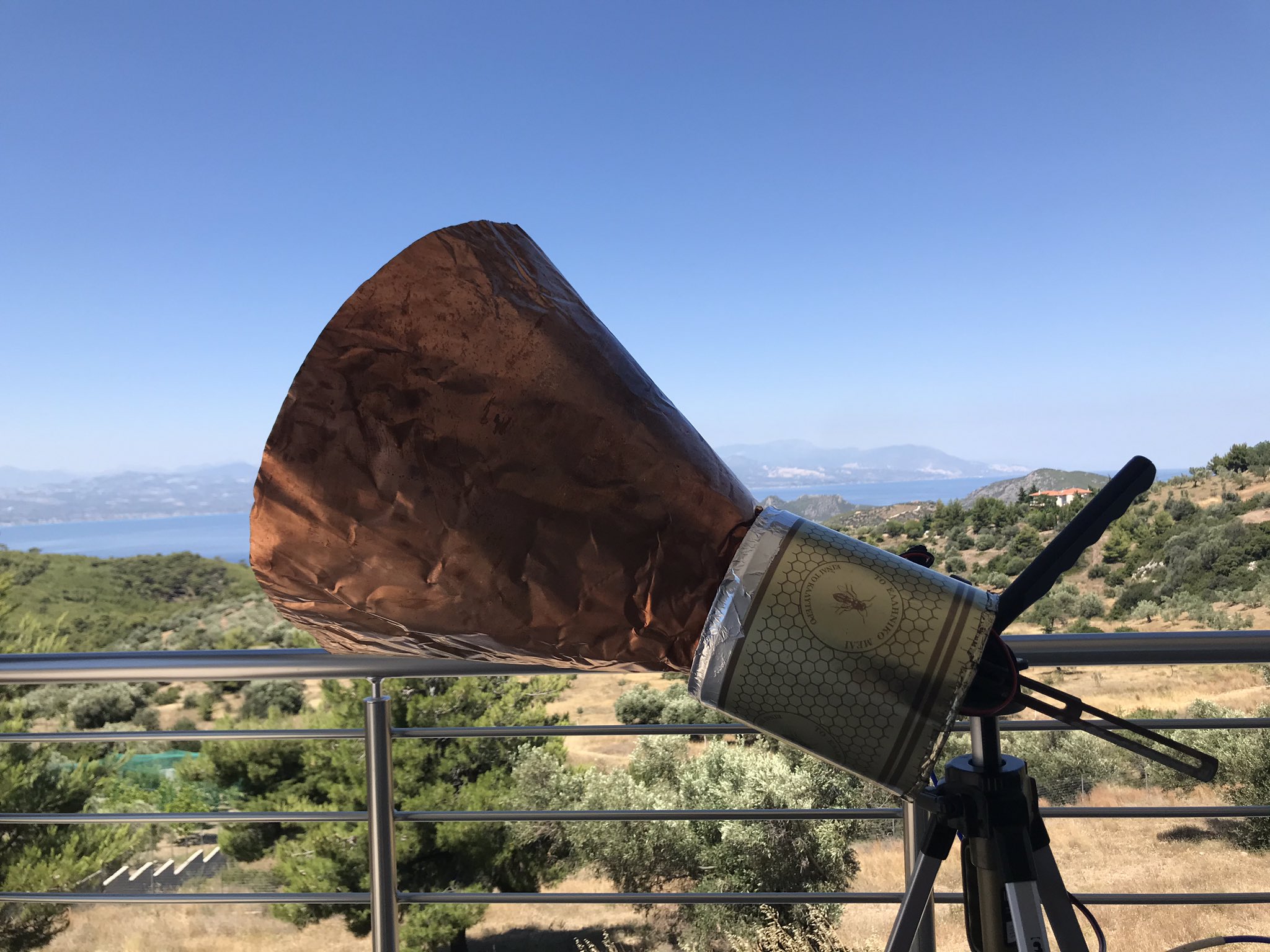
The minimal, portable setup regularly in use here is an Airspy Mini USB SDR , a 40cm diameter helicone on a tripod tracking sats by hand and a 0.2 dB NF LNA.
Details below:
SDR :
SDR Airspy Mini and USRP1 (modified clock 48 MHz, streaming 6 MSPS)
Antenna and Tracking :
a) Hand tracking using a small low noise helicone antenna (see dimensions below)
b) Automated tracking is done using my own Satellite FUN software and a SPID BIG RAS rotator or 2x DiSEqC motors in X-Y configuration.
Relays in the Rot2Prog controller have been replaced by BTS7960 H bridges, see here.
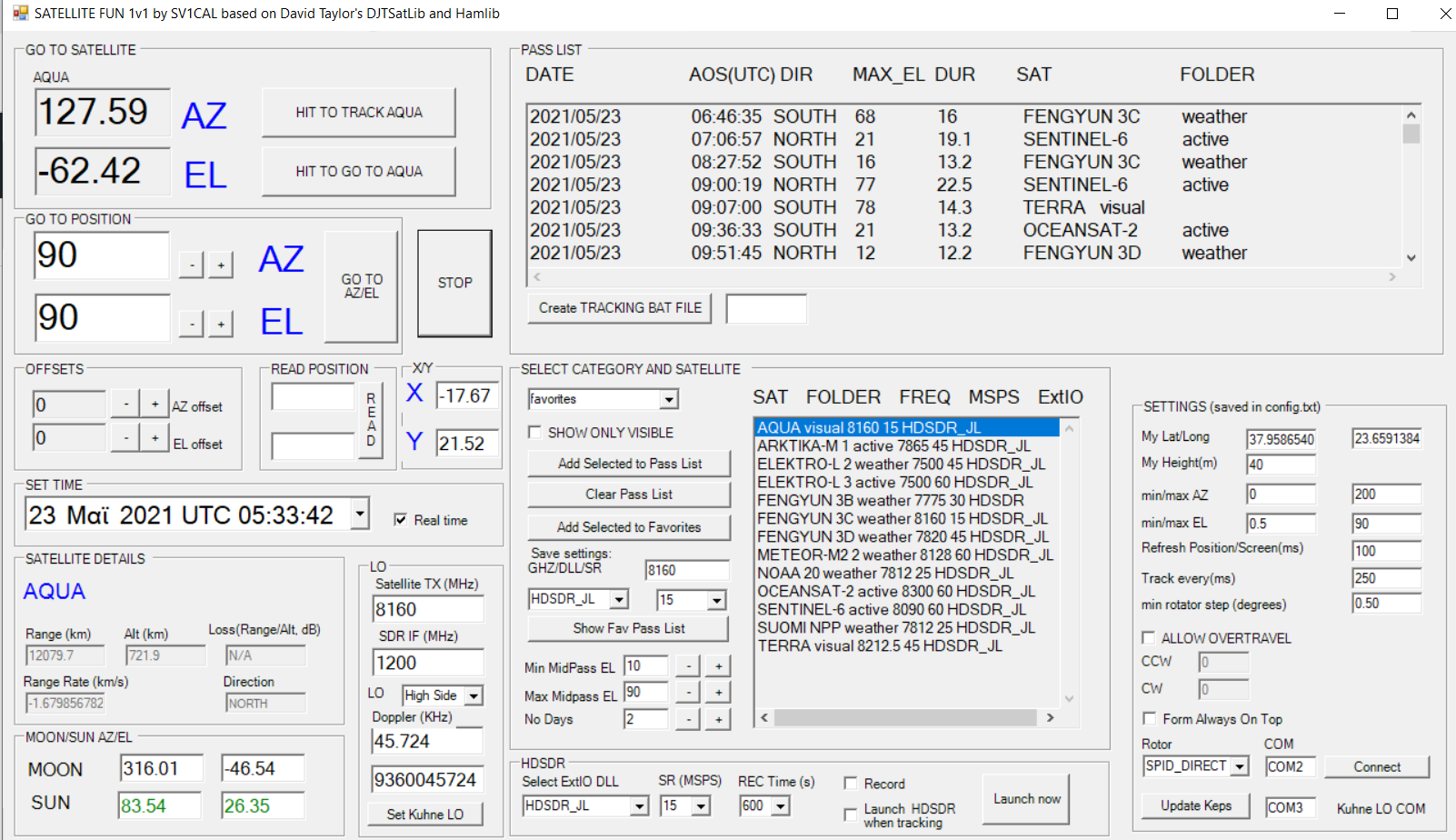
See also my X band feed page and the dual band L/X feed setup currently in use

Low Noise Amplifier:
Modified G4DDK VLNA NF 0.2dB – absolutely important when the low noise helicone antenna is used. If such an LNA is not available I strongly recommend the use of an antenna with higher G/T . I designed the helicone just for experimentation to see e.g what is the minimum aperture that works given a 0.2 dB LNA is used.
For demodulation and decoding one could use one of the following:
a) Aang254’s excellent free SatDump which supports VHF/ L//S/ X band weather satellites and much more :
For visualization / false color images :
a) David Taylor’s HRPT reader and
b) Fred Jansen’s weathersat
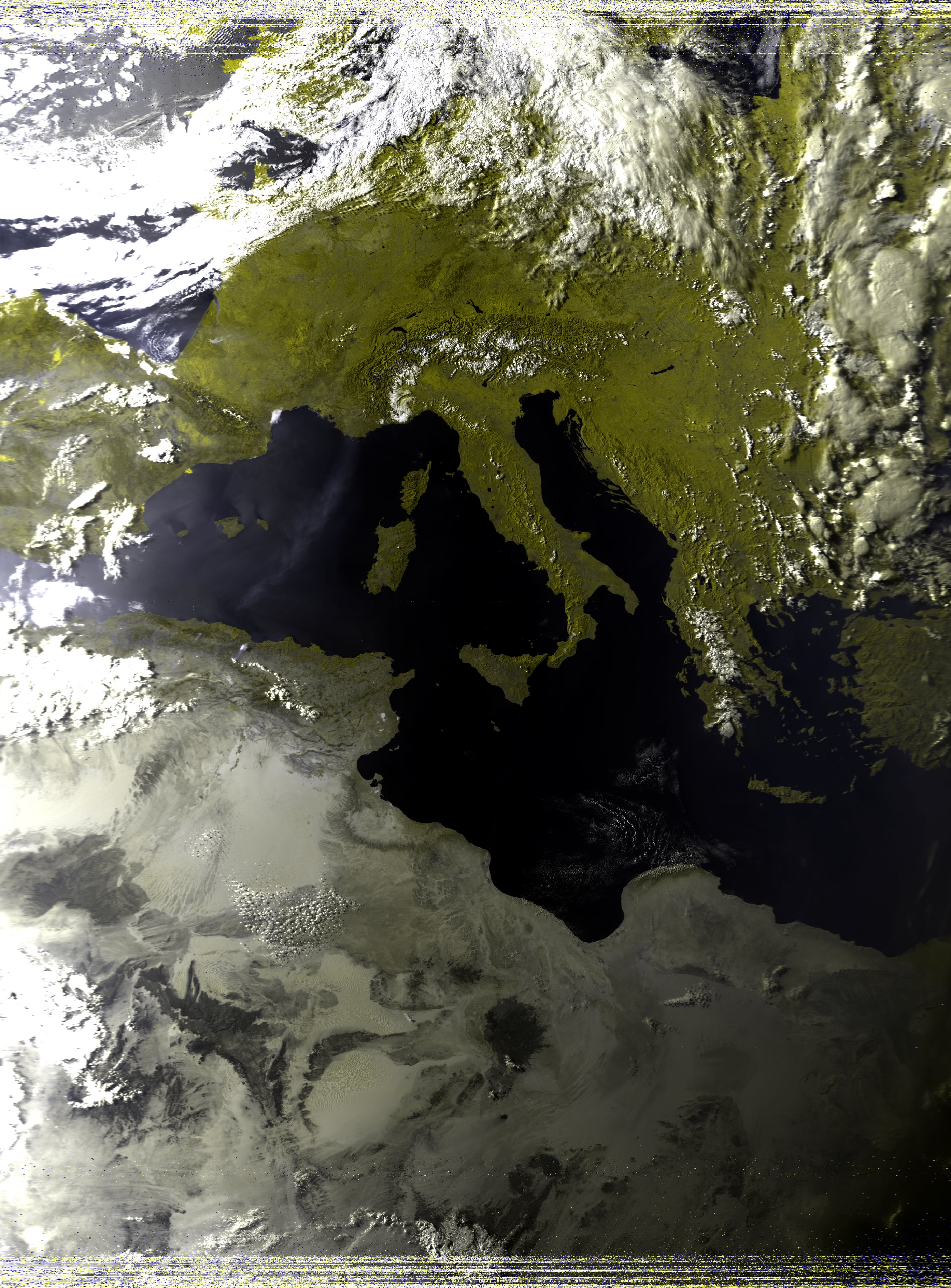
Some pictures showing this small portable setup and what it can do , can be found below.
1.7 GHz helicone design:
The antenna that most use for L band weather sats consists of a satellite dish plus a helical feed or path in the focus.
If you have a 80cm dish or larger and a helical antenna , your first pictures from the satellites won’t be far …so this is the way to get started.
After having gone that path , I wanted to try something different for my own experimentation.
Target was to get better results with a smaller aperture size .
The helicone antenna below has been simulated and optimized in CST Microwave Studio.
The goal was minimum dimensions for acceptable G/T performance.
If you decide to build this antenna, it is absolutely important to use a very low noise amplifier (0.2 -0.3 dB) like G4DDK’s excellent VLNA.
Performance will be poor with the popular Nooelec ~1.2 dB Noise Figure LNAs…Those LNA are nice especially if there is interference as they employ a band pass filter. They require antennas with higher G/T than the helicone to compensate for the higher LNA noise.





 Michael Margaras SV1CAL - Amateur Radio and Electronics
Very good article. I see that the USRP is using sample rate of 2 MSPS. Would that be means RTL SDR also can be used?
Hello, thanks for reading. I haven’t played with the RTL SDR. It may work with some modifications of course. If you give it a try, please share your results. Regards, Michael
Nice write-up on HRPT reception and a blog overall. I have recently started with LRPT and gradually looking for the next steps. I would appreciate if you could share more info on how to deploy and control 2 x DiSEqC motors in X-Y configuration as I have found limited info online.
73 de SV2HZK (Stavros)
Hi Stavros ,
I use the X/Y configuration in a secondary experimental setup . My main setup covers L/X simultaneously as you can see on the X band page .
For the X/Y setup 2 DiseqC motors are controlled using an e-Callisto controller and my own software Satellite Fun . Please check out the e-Callisto page where you can find info about the controller and sample python scripts . Check out also the satellite Fun page where you can find a picture of the assembly and the controller .
Of course on L band with typical antenna size required being around 80cm -1.2m and the wider beamwidth associated , most Passes can be captured with typical Az/El rotors like SPID RAS etc so XY isn’t really required although perfect for overhead passes .
For me my DiseqC X/Y setup is still under development in a sense that I am targeting X band and there accurate pointing and antenna load for a typical 1.2 m dish are an issue.
Of course if you can build your own controller , 2 DiseQC motors would be a cheaper alternative to a SPID Ras to get started .
73s Michael SV1CAL
Hi Michael,
Thanks for the reply and info provided. Exactly e-calisto was the main reference I found, but I did not make the connection with your software!
Nice to know that the specific setup has been tested 🙂
I believe I can give the e-calisto a try as it is the most cost effective solution when DIY for the L-band.
Best,
Hi Stavros,
I think the e-Callisto is about 215 Euros plus shipping and customs fees and a DiseqC motors with metal gears should be around 70-100 Euros each.
Simplifying things one could modify the DiseqCs , just supply DC and control it manually in the beginning adding position feedback later. Or just start with hand-tracking, that’s pretty easy ton L-band .
Other options are the G5500 rotator ( if still around maybe second hand ?) or the SPIDs of course but they are much more expensive (1500+ Euros).
73s Michael
Many thanks for the cost breakdown. Totally agree, starting manually with an AzEl tripod and then moving to the diseqc would be a good starting point. However, having automated the LRPT reception by using a raspberry pi and a simple fixed antenna made me lazy and now my appetite for automated HRPT has increased as well 🙂 But, I am also aware that the higher bands are not so easy so….
Good also to know that the old and famous Yaesu rotor could work. The SPIDs at the moment go way above my initial budget…
73s SV2HZK
Hi Stavros,
By the way, check out the Oleg’s pages below , always a source of inspiration:
http://sat.cc.ua/page1.html
and of course the following advanced setup:
http://sat.cc.ua/page12.html
From what I’ve seen so far with the DiseqC setup , depending on antenna size of course, counterweights are a must as torque is rather…limited.
Small antennas with low wind load will be easily handled but not a 1m dish in windy locations .
To control it a pair of H-bridges and absolute encoders like those sold by DF1SR (HH-12 , HH-12INC) can make a nice setup.
On the other hand, the e-Callisto controller accepts angle commands over the coaxial cables and gets you quickly started.
In addition to SPIDs and the old G5500, people also use telescope (like ioptron etc) or camera mounts (like PELCO) to automate tracking.
Check Scott’s message here:
Have fun experimenting and let me know how it goes !
73s de SV1CAL
Thx, all info noted.
Antenna tracker quest continues 🙂
let’s not forget the SatNOGS project:
https://wiki.satnogs.org/SatNOGS_Rotator_v3
and the promising SuperAntennaz:
https://github.com/YohanHadji/SuperAntennaz
both with a lot of pros and cons of course.
73s SV2HZK